Build Trust and Drive Leads: B2B Influencer Marketing Tactics That Work

Build Trust and Drive Leads: B2B Influencer Marketing Tactics That Work

Does your brand need a push to expand your digital marketing presence? You can add influencer marketing as another channel to expand your reach. 

Influencer marketing is currently making its mark on the digital marketing landscape. And while this marketing activity is popular in the business-to-consumer (B2C) sphere, business-to-business (B2B) brands are slowly making it an integral part of their campaigns, especially in the Philippines.

What Is Influencer Marketing for B2B?

According to Ogilvy, B2B influencer marketing refers to creating partnerships between brands and influential individuals, key industry figures, or subject matter experts.

The practice of influencer marketing is the same for B2C and B2B businesses – seeking help of famous personalities in promoting brands. However, B2C brands often go to flashy personalities and the latest dance craze while B2B brands focus on accomplished professionals to accomplish this goal. 

For B2B companies, the aim of influencer marketing is to leverage the popularity of the following influencers: 

  • Industry analysts or respected figures providing independent research and insights.
  • Expert consultants and advisors offering guidance and solutions to businesses in your niche.
  • Leading journalists and broadcasters who publish magazines and other papers in your industry.
  • Professors and researchers with academic credibility and specialized knowledge.
  • Customer advocates or satisfied clients who champion your brand and are open to share their positive experiences.
  • Experienced employees with the expertise and potential to promote your brand. 

Why Invest in B2B Influencer Marketing?

According to Asia Pacific Insights: Influencer Marketing Report 2023 by Partipost, an overwhelming majority (92%) of the surveyed Filipino companies have tried influencer marketing in 2023 compared to 76% in 2021. 

Philippine brands that allot 10% to 50% of their marketing budget for this task also doubled from 32% to 50%. On the side of users, more than 90% of Filipinos surveyed prefer influencer accounts over brand accounts, seeing these as more relatable content. 

These figures were echoed by another report, this time by Ogilvy. In a survey of 550 Chief Marketing Officers across 11 Asian markets including Malaysia, Philippines, Singapore, and Vietnam, 75% of the brands are already engaging in influencer marketing. Of these, 93% of the participants are planning to increase the adoption of this marketing practice. 

Overall, the survey found the majority of participants have a positive view about influencer marketing. A staggering 92% of survey participants believe using B2B Influencers for hyper-targeted marketing or personalized messaging is an effective strategy for increasing brand consideration and customer acquisition.

Influencer is the Digital Version of Word-of-Mouth

According to Ogilvy, by 2025, 75% of the workforce will comprise digital natives who have a distinct form of social relationships. Hence, businesses have to adapt to the new norm of communication, with digital becoming increasingly integrated with our physical interactions.

This condition will lay a fertile ground to the growth of popularity of influencers as word-of-mouth advocates. They fill in the requirements of the traditional word-of-mouth, which is an honest and genuine opinion coming from relatable experiences from real people you can trust.

Word-of-mouth is among the marketing activities with the highest efficacy rate in the B2B marketing landscape. In fact, this marketing tool impacts 91% of B2B sales, in a way. 

How B2B Influencers Can Leverage Brands

Through influencer marketing, your brand can:   

  • Build relationships and collaborations with individuals or organizations carrying significant weight within your target B2B audience.
  • Capitalize on their expertise and influence to promote your brand, product, or service.
  • Build long-term, strategic partnerships aimed at establishing your brand as a thought leader and trusted authority within the industry.

What’s more, exposure of your product or service through these personalities can increase brand awareness and credibility, generating leads and qualified traffic. It can also help you create more authoritative content and thought leadership. Your brand can also build positive associations with respected industry voices. 

How B2B Influencer Marketing is Done?

  • Thought leadership collaborations that can foster partnership with industry experts for webinars, white papers, or blog posts to establish brand credibility and knowledge authority.
  • Social media campaigns that leverage influencer networks for targeted content promoting events, webinars, or case studies to reach relevant decision-makers.
  • Community management that opens doors for your brand to engage with B2B communities and forums through establishing thought leadership, answering questions, and building organic relationships.
  • Local event sponsorships during industry conferences, seminars, or meetups that will connect your brand with key players and potential customers.
  • Micro-influencer partnerships that will allow you to engage with smaller, yet highly trusted individuals with specialized knowledge within your niche.

Where to Find B2B Influencers?

Spotting the right person as a B2B influencer can be a challenge. Here are some popular venues where you can find them:

  • Marketing magazines and blogs. Look for articles featuring B2B influencer marketing case studies in the Philippines or Southeast Asia related to your brand.
  • Industry award websites. Check for award announcements highlighting successful B2B influencer campaigns in your specific industry.
  • Marketing agencies and consultancies. Contact local agencies specializing in B2B marketing or influencer marketing for insights and potential case studies.
  • Social media platforms. Go to LinkedIn and other platforms to search for relevant discussions and content shared by B2B influencers in your field.
  • Networking events. Attend industry events and conferences to connect with potential influencers and hear about successful marketing strategies.

Lack of B2B Influentials’ Utilization

However, despite the CMOs’ optimism for the influencer marketing’s impact to better ROI, its potential is still far from reaching its full realization. The research found that companies do not assign a team to fully utilize its aftersales influence even though 47% of respondents agree B2B influencers could have the biggest impact during aftersales. 

Influencers are also far from fully utilized in lead generation, considering 60% of CMOs have yet to experience improvement in lead generation from B2B marketing activities. 

How to Improve Your B2B Influential Campaigns

To win big in B2B influencer campaigns, you need substance, collaboration, and strategic planning.

Here’s a step-by-step guide to crafting campaigns that resonate with decision-makers while elevating your brand within your niche.

Step 1: Define Campaign Goals & Objectives

You need to specify what exactly you want to achieve. 

Are you cultivating

  • brand awareness
  • lead generation
  • content creation 
  • thought leadership?

From your chosen objective, set Specific, Measurable, Achievable, Relevant, and Time-Bound (SMART) goals. Then align them with your chosen influencers’ skills and reach.

Step 2: Choose talent wisely

Carefully come up with personality profiles that define who these influencers are. Make sure your brand voice and values fit with yours. Each Influencer possesses a unique voice that resonates with a specific portion of your customer base. Remember, they are your company’s extended mouthpieces. The content they produce is associated with your brand image. 

Step 3: Choose the Right Format and Platform

Pick the right format that will impact your target audience and influencers’ strengths. Don’t just jump on trending formats.

Here are some content formats to choose: 

  • Industry articles and reports: If you want to establish your authority, partner on in-depth research or white papers showcasing your company’s expertise.
  • Webinars and live events: To spread brand awareness, leverage interactive sessions for thought leadership and engagement.
  • Social media campaigns: Attract qualified leads on platforms where your target market is. Through this, you can highlight your brand and collaborate on targeted campaigns tailored to specific platforms and influencer audiences.
  • Podcasts and interviews: Create relevant and quality content using audio formats for in-depth discussions and industry insights.

Step 4: Invest in Valuable Partnerships

Nurture your partnership that goes beyond financial by taking time to invest in these partnerships. 

Find time to introduce your brand to your selected influencers and educate them about your products. Invite them to your business development meetings, have them meet your employees. 

By building strong, meaningful, long-term relationships with Influencers they can get invested in your brand’s purpose and naturally advocate for it. 

Step 5: Co-create Authentic and Valuable Content

Avoid scripted pitches and generic topics. Focus on:

  • Industry relevance: Address current challenges, trends, and pain points within your niche.
  • Data-driven insights: Leverage the influencer’s expertise and research to offer valuable perspectives.
  • Thought leadership: Position your brand as a leader in the conversation through insightful content.
  • Storytelling and case studies: Showcase real-world applications and tangible benefits of your solutions.

Step 6: Promote and Amplify Campaign Reach

Now that your chosen influencer has already produced content, don’t let it stay siloed. Leverage your platforms and networks to maximize reach through:

  • Cross-promotion: Feature influencer content on your website, social media, and email marketing.
  • Paid advertising: Consider strategic targeting to reach relevant audiences beyond the influencer’s immediate followers.
  • Industry outreach: Share the campaign with relevant publications, communities, and thought leaders.
  • Engage the influencer’s audience: Actively participate in discussions and respond to comments, building deeper connections.

Step 5: Measure and Refine for Continuous Improvement

Never forget to track your campaign’s impact through these metrics:

  • Website traffic and leads: Check out the traffic generated and leads linked to the influencer campaign.
  • Brand sentiment and awareness: Monitor online conversations and brand mentions related to your campaign.
  • Engagement and reach: Track reach, impressions, and engagement metrics on the influencer’s and your own platforms.
  • Return on investment (ROI): Evaluate the overall impact on your business goals and marketing objectives.

Start Your B2B Influencer Journey with LeapOut

Nearly all marketing experts and CMOs recommend B2B companies to include influencer  campaigns in their digital marketing mix. While you can initiate this in your company, you still need an experienced digital marketing agency like LeapOut to conceptualize, enforce and sustain this marketing activity in your business. Contact us now to kickstart your B2B influencer marketing for B2B for this year. 

Picture of Tony Chua
Tony Chua

Tony Chua is an adept Web Content Specialist and HubSpot-certified professional, with an Economics degree from the University of Santo Tomas and over ten years in content creation. Specializing in SEO articles, blog posts, and social media content, Tony has a diverse background encompassing news writing, press releases, and editorial work.

His multifaceted expertise also covers desktop publishing, graphic design, web development, and video editing. At LeapOut Digital, Tony applies his versatile skills to enhance digital narratives and engage a global audience through compelling content.

RECENT BLOGS

From Noise to Intelligence: How LeapOut and Meltwater Safeguard Public Trust for Government and Political Leaders

In the Philippine digital landscape, public sentiment is a volatile force. For government agencies and political figures, online conversations are no longer just “feedback”—they are the front lines of governance and reputation. In an environment characterized by coordinated narrative shifts, misinformation, and high-stakes accountability, social listening in the Philippines has evolved. It is no longer about monitoring “likes”; it is about defending the truth and maintaining institutional stability. Learn more about our comprehensive community management services and how we help organizations maintain authentic digital engagement. 1. The High-Stakes Reality of Public-Sector Discourse In 2026, the digital space for Philippine leaders is defined by three distinct pressures: Narrative Weaponization: Detractors and political opponents often use coordinated amplification to distort policy rollouts. The May 2025 “Bayan Muna Red-Tagging” incident demonstrated how false claims about party-list disqualification could spread faster than official COMELEC clarifications, utilizing coordinated social media “shouting” to drown out the truth. The Misinformation Epidemic: False claims can go viral in minutes, causing public panic or eroding trust in government institutions. The May 2024 Marcos deepfake incident—where sophisticated audio fabrication portrayed the President ordering aggressive military action—required immediate multi-agency mobilization to prevent international diplomatic escalation. In a country where 90.8 million active social media users represent 78% of the total population, a single piece of manufactured content can reach critical mass within hours. The Demand for Transparency: Citizens expect real-time responsiveness and absolute accountability. Yet 98.9% of Filipinos use chat and messenger services monthly—”dark social” channels where disinformation spreads invisibly to basic monitoring tools. Government agencies face the impossible task of maintaining transparency across platforms they cannot even see without enterprise-grade intelligence infrastructure. At LeapOut, we believe that for government agencies, intelligence must precede communication. You cannot lead a conversation you do not fully understand. And in 2026, understanding requires capabilities that match the sophistication of those seeking to manipulate public opinion. 2. LeapOut & Meltwater: The Gold Standard for Public Intelligence The threat landscape facing Philippine government institutions is no longer theoretical. It is documented, quantified, and escalating: Foreign Interference Operations: Recent investigations have uncovered multi-million peso operations managing massive networks of fake accounts posing as teachers, laborers, and government employees to manufacture grassroots authenticity for foreign propaganda. In April 2025, the National Security Council flagged the use of local proxies to amplify divisive narratives and undermine the administration’s national security positions. Industrial-Scale Coordinated Inauthentic Behavior: Meta’s May 2025 pre-election takedown removed thousands of fake accounts and pages days before the May 12 midterm polls—part of what researchers termed an “intensified firehose of falsehoods” designed to manipulate voter behavior at scale. AI-Powered Disinformation: Deepfake technology has moved from experimental to operational. Hyper-partisan vlogger networks have deployed coordinated campaigns spreading fabricated allegations against high-ranking officials, requiring immediate institutional response to contain damage. Our content marketing strategies help organizations develop authentic narratives that build trust and counter misinformation effectively. Managing public perception in this environment requires enterprise-grade tools. LeapOut partners with Meltwater to provide government units and political leaders with a secure, robust intelligence ecosystem capable of matching these sophisticated threats. Audit-Ready Data: Every insight is backed by a transparent data trail, essential for government compliance and reporting. When the Philippine National Police requested removal of 1,372 malicious posts in August 2025 alone, agencies needed documentation that could withstand legal scrutiny. Hyper-Local Depth: Monitoring across Facebook, TikTok, X, Viber, WhatsApp, Telegram, and localized forums where regional political discourse actually happens. Basic tools miss the 98.9% of Filipinos using messenger services—precisely where coordinated campaigns operate beneath public visibility. Explore our TikTok marketing expertise to understand how we navigate emerging social platforms where misinformation spreads rapidly. Predictive Alerting: Advanced Boolean monitoring that flags potential PR crises or security threats before they breach the mainstream. The difference between containing a deepfake within niche channels versus managing international diplomatic fallout is measured in minutes, not hours. 3. Critical Focus Areas for Government Agencies Narrative Defense & Crisis Mitigation We identify the “Patient Zero” of a misinformation campaign. By tracking how a false narrative spreads—whether it’s a multi-million peso foreign interference operation or a coordinated red-tagging campaign—we help agencies intervene at the exact point of escalation. When thousands of fake accounts activated days before the 2025 midterm elections, agencies with structured intelligence capabilities could distinguish between genuine voter discourse and manufactured amplification. Citizen Sentiment & Policy Impact How do Filipinos really feel about a new department order or legislative bill? With 90.8 million active social media users generating content across dozens of platforms and dialects, separating signal from noise requires more than keyword tracking. We filter out the “loud minority”—including the coordinated networks posing as “working-class Filipinos”—to provide leaders with an accurate pulse of genuine public sentiment. Our social media advertising services leverage similar intelligence frameworks to reach authentic audiences and maximize campaign effectiveness. Identifying Coordinated Inauthentic Behavior (CIB) Distinguishing between genuine citizen grievances and “troll farm” activity is crucial. When hyper-partisan vlogger networks deploy coordinated campaigns, or when foreign proxy operations invest millions in manufacturing grassroots authenticity, leaders need intelligence systems that recognize behavioral patterns, timing anomalies, and network structures that reveal coordination. We help leaders ignore artificial noise and focus on real constituent needs. Foreign Interference Detection The National Security Council’s April 2025 identification of local proxies amplifying divisive narratives demonstrates that foreign interference is not abstract—it is operational and targeted. LeapOut’s monitoring frameworks are specifically designed to detect the linguistic patterns, funding indicators, and coordination signatures that distinguish foreign influence operations from domestic political discourse. 4. The LeapOut Workflow: Protecting the Mandate Step Focus for Leaders Outcome Real-World Application 1. Architecture Mapping Political Opponents & Key Issues A tailored “early warning system” Identifying multi-million peso networks before they achieve narrative dominance 2. Monitoring Real-time CIB & Misinformation Detection Separation of real feedback from bots Flagging coordinated activity across 90.8M users before Meta’s takedown 3. Analysis Risk Categorization (High/Medium/Low) Prioritized response for leadership Assessing deepfake threat level requiring multi-agency mobilization 4. Activation Strategic Narrative Counter-measures Reclaiming the truth through PR/Social PCO’s rapid response preventing

Continue Reading

What Building on Shopify Taught Us About Scale, Systems, and Stewardship

Over the years, I’ve noticed that most conversations about e-commerce platforms are overly simplified. Shopify is often described as fast but limited, flexible but lightweight—great for startups, less so for serious scale. Our experience tells a more nuanced story. At LeapOut, we’ve built Shopify stores for brands at very different stages: legacy institutions, global brands, regulated organizations, and fast-growing challengers. Each project came with its own context, constraints, and expectations. What became clear over time is this: Shopify works best when the build respects the brand’s story rather than forcing a template onto it. Shopify Is Not One Thing Shopify is not a single experience. It behaves very differently depending on scale, governance, and ambition. A DTC startup, a national brand, and an enterprise organization may all use Shopify—but the way the platform must be architected changes dramatically as complexity increases. That realization shaped how we approach every Shopify development build today. Each brand we’ve worked with taught us something distinct. Every Shopify Brand Has a Story   Bench (Shopify Plus): Continuity Over Disruption Bench is more than a retailer in the Philippines—it’s a cultural institution. Many of us grew up with the brand, which made this project feel personal from day one. Our work on Shopify Plus focused on continuity. We had to factor in historical data, existing enterprise workflows, and future corporate plans without disrupting a brand that already worked at scale.  The key lesson was simple but powerful: not every brand needs reinvention—some need careful stewardship.   Under Armour Philippines (Shopify Plus): Governance at Scale Under Armour was one of the most demanding Shopify environments we’ve handled. The work required deep front-end customization aligned with global brand standards, strong performance discipline, and careful stakeholder alignment across teams. Shopify Plus gave us the flexibility—but scale demanded governance. This project reinforced a truth we see often: flexibility without structure creates risk.   Reebok (Shopify Plus): Designing for Longevity Reebok was our first major Shopify Plus build—and one of the most formative. At the time, it pushed us to think beyond launch cycles. We had to design theme architecture, performance optimization, and front-end decisions that could hold up over time. Four years later, the store is still running. That longevity remains one of our proudest indicators of success.   MaxiLife by Maxicare (Shopify Plus): Precision Under Constraint Healthcare-adjacent commerce brings a unique kind of complexity. For MaxiLife, we implemented deep technical customization to meet regulatory requirements while ensuring the experience remained intuitive and human. Shopify Plus allowed us to extend the platform safely—but precision was non-negotiable. The takeaway was clear: constraints don’t eliminate good experience—they demand better design.   Kultura: Scale Through Discoverability Kultura carries one of the deepest inventories we’ve worked with. The challenge wasn’t volume—it was discoverability. Our work focused on navigation architecture, SEO structure, and product taxonomy to help customers find meaning within abundance. Scale without clarity, we learned, quickly becomes friction.   Crate & Barrel Philippines: When Invisibility Is Success Crate & Barrel required a different posture altogether.  Our role centered on Shopify SEO and supporting a platform migration with minimal disruption. The goal wasn’t visible change—it was continuity.  In enterprise environments, the absence of failure is often the highest measure of success.   Chicco Philippines: Operational Complexity Behind a Gentle Brand Chicco’s challenge lay beneath the surface. Oversized products like strollers required complex shipping logic and fulfillment considerations that standard setups don’t address. This project reminded us that good commerce design must account for operational reality, not just aesthetics.   Belomed: Speed With Intent Belomed came with a firm deadline: launch in six weeks, in time for the 2025 holiday season.  The work required disciplined prioritization and focused execution. Performance post-launch validated the approach, and the platform now serves as a foundation for more ambitious technical plans.  Speed, we learned, only works when paired with intent.   Saucony Philippines: Translating Heritage Forward  Saucony’s relaunch was about balance. We had to honor the brand’s origins while making it relevant to a modern audience. The project involved close collaboration and gradual capability building with the local team. Growth has followed steadily—proof that heritage only works when it’s translated forward.   OUR HOME: Progress That Compounds OUR HOME reflects the quieter side of growth. From early SEO work in 2021 to later UX, navigation, and content improvements, the store has evolved through consistent, incremental enhancements rather than dramatic redesigns.  It’s a reminder that long-term improvement compounds quietly—but powerfully.   Kotis Design (USA): Extending Shopify Beyond Its Defaults Kotis Design, a US-based B2B brand serving Fortune 500 clients, exceeded Shopify’s native customization limits. We built a custom Shopify app to support complex product personalization—marking a milestone in our understanding of Shopify as an extensible platform.  Platform limits, we found, are often design limits—not technical ones.   Body Wrappers USA: Community as a Constraint Body Wrappers is a legacy brand deeply rooted in the global dance community.  Post-relaunch, performance and conversion improved—but more importantly, the work reinforced how community changes design decisions. When you serve a community, responsibility increases. Sports Central: Growth Shared Over Time   Sports Central was our first professional Shopify build, completed during the pandemic.  Watching the brand grow since then has been one of the most rewarding parts of our journey. It reminds us that meaningful outcomes are rarely visible at launch—they emerge over time.   Shopify Plus as a Pattern Across these projects, Shopify Plus emerged not as a feature set, but as a pattern.   It appears when: scale introduces real risk governance becomes essential decisions must endure beyond teams and agencies Shopify Plus doesn’t simplify complexity—it reveals it.   Designing for What Comes Next  Today, our Shopify work increasingly accounts for a Gen-AI–driven future.  We’re designing platforms that are interpretable by intelligent systems—through clean data structures, clear taxonomy, and durable content architecture. SEO is no longer just about ranking, but about being understood. We’re also expanding Shopify into food, services, and hybrid business models—focusing not on “pretty websites,” but on future-proof platforms

Continue Reading
Leapout-underarmour2

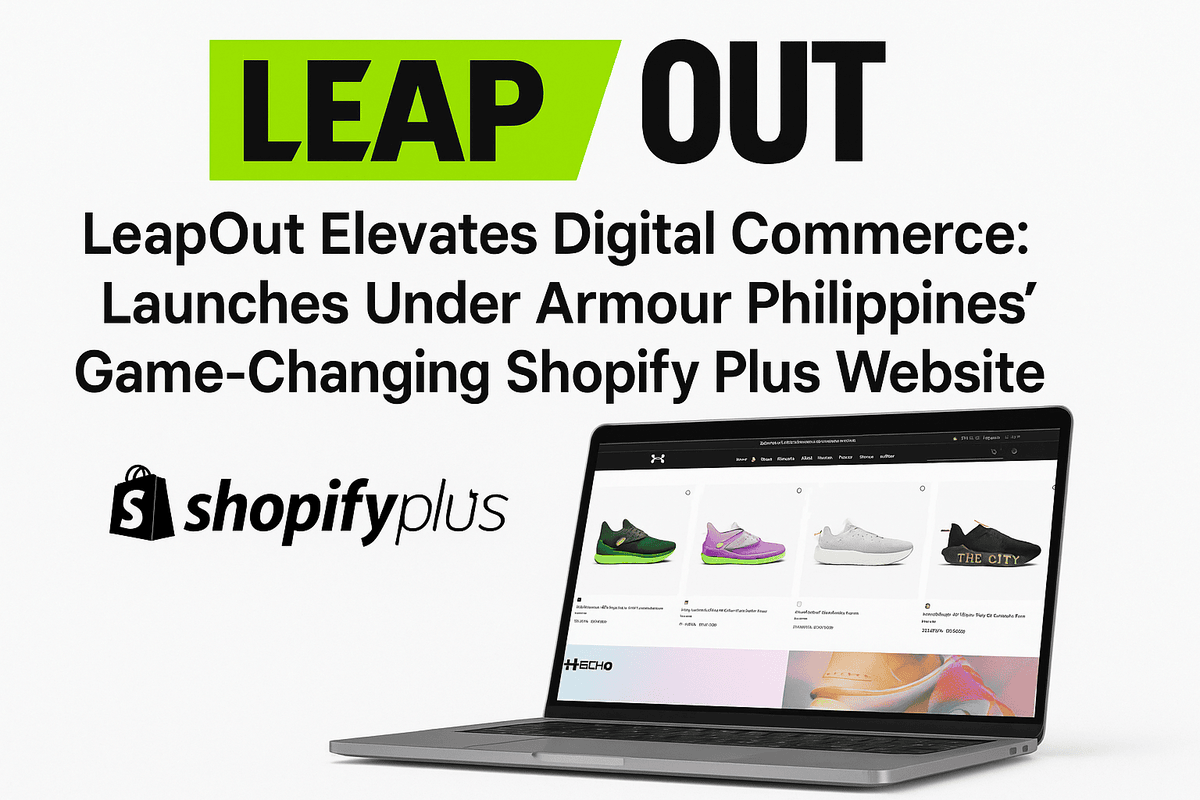
LeapOut Elevates Digital Commerce: Launches Under Armour Philippines’ Game-Changing Shopify Plus Website

MANILA, PHILIPPINES – July 1, 2025 – LeapOut, the Philippines’ premier digital commerce and Shopify Plus agency, proudly announces the successful launch of the groundbreaking new Under Armour Philippines e-commerce platform. Engineered on Shopify Plus—known globally for scalability and performance—this fully customized website offers users an immersive digital experience that mirrors Under Armour’s global prestige, setting a new benchmark for online sports apparel retail in the region. This transformative project involved a meticulous, from-the-ground-up redevelopment designed to provide athletes and fitness enthusiasts an intuitive, seamless, and captivating user journey. From the visually dynamic homepage to precision-crafted collection and landing pages, each feature was strategically developed by LeapOut to deliver both immediate functionality and enduring adaptability. The launch marks a major milestone, achieved through navigating complex approval channels involving both the official Philippine distributor and Under Armour’s global leadership. The successful delivery of this ambitious project underscores LeapOut’s capacity to seamlessly manage stakeholder alignment on a global scale. Reflecting on the achievement, Ruben Fortes, Project Lead at LeapOut, stated, “This project represents more than a technical accomplishment; it embodies our commitment to pushing the boundaries of what digital commerce can achieve. It’s a convergence of relentless dedication, innovative thinking, and strategic collaboration—resulting in an elevated experience that is both meaningful and powerful for the Under Armour community.” Technical excellence underpinned the project’s success. LeapOut’s team of expert developers and engineers built a site that was visually striking, technically robust, and designed explicitly for scalability. June Dolendo, LeapOut’s Senior Developer and Head of Technology, articulated, “In crafting the Under Armour digital experience, we meticulously considered every interaction, every component, and every pixel—ensuring each element contributes to a cohesive, responsive, and delightful user experience. This meticulous approach to digital architecture and design reflects LeapOut’s unwavering commitment to excellence and innovation.” This launch further solidifies LeapOut’s esteemed portfolio, placing Under Armour alongside other iconic brands like Reebok, Bench, Aldo, Kultura, Maxi Life, Pet Express, Toy Kingdom, Chicco, and numerous leading labels under SM Retail, Inc. LeapOut has also successfully built an impressive client base in the USA and Australia, showcasing its global capability and trusted expertise in managing sophisticated digital projects. LeapOut: Empowering Brands from First Sale to Full Scale The successful Under Armour launch reinforces LeapOut’s fundamental mission: guiding businesses from their very first online sale to full-scale digital leadership. LeapOut’s distinctive approach equips SMEs and enterprises alike to invest strategically in digital infrastructure, ensuring each step fuels sustainable growth. At LeapOut, websites aren’t just built—they’re transformed into powerful engines of digital growth. Combining industry-leading technology with strategic business acumen, LeapOut continues to distinguish itself as the partner of choice for brands committed to dominating the digital space. Explore Under Armour Philippines’ transformative digital experience here: https://www.underarmour.com.ph/

Continue Reading